- Learn how to manage a vertical farm efficiently by optimising crop production and climate conditions.
- Combine plant physiology, technology and business strategy to build a profitable vertical farming operation.
- Visit innovative vertical farming facilities and apply new insights directly to your own practice.
- Optimise crop production by fine-tuning lighting, climate and growing conditions for maximum yield and quality.
- Build a strong international network of vertical farming experts, growers and technology suppliers.
Short
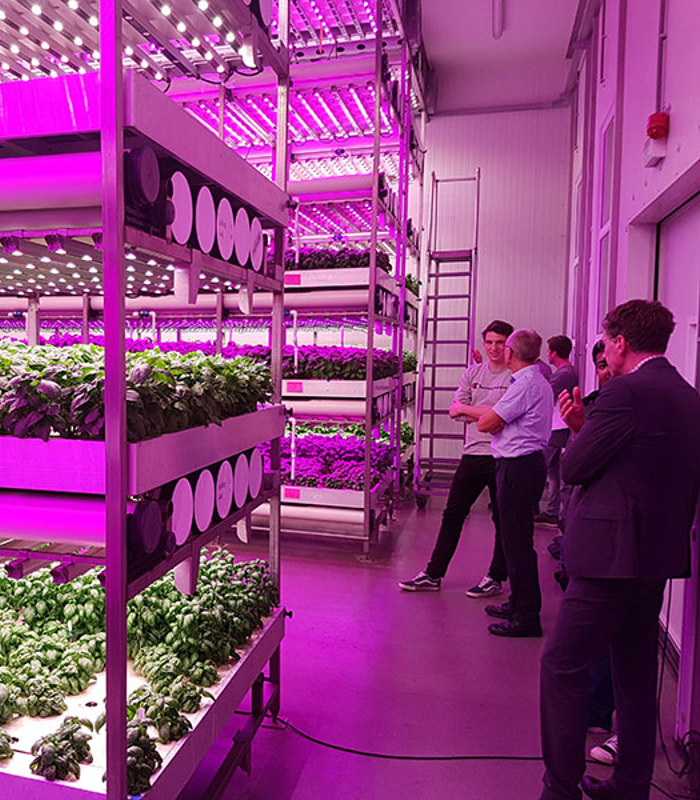
Vertical farming (indoor farming without daylight) is a development that takes horticulture to another level. With Light Emitting Diodes (LED) it is possible to offer plants the perfect light conditions, while other climatic factors are also completely controlled. The course is about the practical applications of vertical farm management.
Why take this course?
About the course
HAS green academy has many years of experience in successfully growing crops exclusively lit by LED in both research and large-scale production cells. We now offer a production management course to share our knowledge and experience with professionals from horticulture and related industries with special interest in vertical or city farming.
Result after the course
After taking the course Managing a vertical farm you know all about:
- Which crops are interesting to grow in a vertical farm and their yield.
- How to sow, germinate and transplant/space different crops.
- Characteristics of and cultivation in different substrates and information on fertilizing.
- Optimal climate settings in a VF.
- Product quality and shelf life.
- Sustainability aspects, including energy use.
About the course
Content of the course
The course consists of four days. Each day takes place at a different location and has its own theme. The provisional programme is as follows:
Day 1: Crops, varieties and yield potential – HAS green academy Den Bosch
Today you will receive a general introduction to the course and to vertical farming. In this module, you will learn which crops have potential for LED cultivation, including suitable varieties and expected yields. We will also look at the basic plant-physiological aspects of growing plants in a vertical farm. The focus will be on photosynthesis, light measurement, light calculations, and plant water management. In the afternoon, an excursion is scheduled.
Day 2: Seeds, sowing, substrates – HAS green academy Den Bosch (morning) – Amsterdam (afternoon)
During this module, you will learn how to sow, germinate and transplant various crops in a vertical farm. Attention will also be given to different substrates for sowing and propagation. Additionally, this day covers the characteristics of and cultivation in different substrates in combination with irrigation systems such as aeroponics,
hydroponics, dry hydroponics, ebb and flow, and Nutrient Film Technique. Fertilisation strategies for plants in a vertical farm will also be discussed.
Day 3: Climate control and building a vertical farming business – Brightlands Campus Venlo
This module covers optimal climate settings regarding light, temperature, humidity, CO₂ levels and air speed. We will also discuss product quality and shelf life in vertical farming. In addition, several companies and facilities in and around the Brightlands Campus in Venlo will be visited.
Day 4: Business case, hygiene and sanitation, post-harvest – location to be determined
On the final day, we will take a detailed look at lighting. We will examine the effects of light spectrum, day length and light intensity on crop growth in a vertical farm. You will learn about general hygiene protocols and why they are essential. Both plant diseases and pests, as well as human bacterial diseases, will be discussed in relation to hygiene protocols and disinfection methods. We will also look at the sustainability of vertical farming systems. The day concludes with an excursion and a joint closing session during which participants will receive their certificates.
For who
This course is developed for everyone who is working in or will start a vertical farm.
Guidance
This course is taught by experienced HAS lecturers. HAS green academy has her own vertical farming facilities. Also, several partners will be visited to gain further practical knowledge and we offer different network opportunities in the evening with suppliers of climate chambers, light, software, climate computers , etcetera in vertical farming.
After enrollment, we will discuss with you your wishes and we will invite the partners.
The course offers a good balance between overview of the sector and in-depth knowledge on certain topics. Because of this, I have developed an understanding which makes it easier for me to coordinate with different experts within the vertical farming sector.
Joris Goossens
Participant
Practical information
What do you need to enroll in this course? And what else is good to know?
Good to know
Start and course dates
The duration of the course (excl. the online part) is one intensive course week.
The course is currently being planned.
Course days last from 9:00 until 17:00 and will take place in multiple different locations. More information about this can be found under Course content.
Requirements
To enroll in this Bsc+ level course, you should at least have:
- Successfully finished the online course Growing without daylight, or;
- Comparable knowledge acquainted via other courses or practical experience. Please discuss this with the course leader.
Completion of the course
After successfully completing the course you will receive a certificate of participation from HAS green academy.
Course price
- Investment
-
€ 2.945,00excl. VAT
Price specification
- Course price
-
€ 2.745,00
- Catering arrangement
-
€ 200,00
- Total price
-
€ 2.945,00excl. VAT
All amounts mentioned are excluding VAT. Training costs, including course material, are exempt from VAT. All other costs are charged with 9% VAT.
Hotel stays are not included in the price. Upon request, we can recommend hotels in the nearby area.
Catering:
- Coffee, tea and water
- Soft drinks
- Fruit
- Lunch
- Small snacks
- Drinks
- Excluding dinner
Any bank/administration fees are for your own account.
Questions? Please get in touch with us!
-
![Photo Lamiaâ Fareh]()
Lamiaâ Fareh El Btioui
Projectmanager Business courses
- l.fareh@has.nl
- l.fareh@has.nl
- +31 88 890 37 74
- +31 88 890 37 74